
Stamford Projected and Actual Release
The public CT DOC detail field is labeled "Estimated Release Date." It is the closest match to a projected or tentative date for a sentenced Stamford person in state custody. The same detail record may also show a Maximum Release Date and Special Parole End Date. Each date means something different. The estimated date reflects the current release calculation. The maximum date is tied to the sentence ceiling after applicable calculations. The special parole date marks the end of a post-prison supervision term, not the day the person exits prison.
Actual release is the custody event that occurs after DOC processes the governing sentence, credits, detainers, orders, and release authority. CT.gov warns that release dates are subject to change and that the public system may not show every status in real time. The displayed estimate should therefore be recorded with the date it was checked and verified close to the expected release.
A pretrial detainee is different. Someone held after a Stamford arraignment may be at Bridgeport Correctional Center or York Correctional Institution, but has no sentence-based projected release date. Bond, a new court order, a disposition, or a transfer can end or alter that custody. A person released by Stamford Police before CT DOC commitment has a local police or court release event, not a DOC estimate.
Scheduled vs actual: CT DOC's Estimated Release Date is changeable. Only the processed release event confirms when custody ended and whether another agency took custody.
Find a Stamford Projected Release Date
Stamford has no county jail sentence calculator or county sheriff release portal. Connecticut centralizes jail and prison custody in CT DOC. That makes the statewide inmate search the first date source for a sentenced person, while Stamford court records explain the sentence that DOC is administering. Local police records apply when the person was released before state commitment.
- Gather the legal name, date of birth, and CT DOC inmate number if known. The inmate number is the most direct identifier.
- Open the CT DOC inmate information search. Search by inmate number alone, or begin with the first few letters of the last name and narrow with first name and date of birth.
- Match the date of birth and current location. A Stamford male detainee may be routed through Bridgeport Correctional Center, while a female detainee may be held at York Correctional Institution.
- Open the detail record. Read Status and Current Location before interpreting any date.
- Compare Maximum Release Date, Estimated Release Date, Special Parole End Date, and Detainer. Do not substitute one field for another.
- Check the Judicial Branch case lookup for the sentence, mittimus, probation, special parole, bond, or later sentence change.
- When the date is close or the public result is missing, contact DOC Public Information and use VINE for the custody-change notice.
The CT DOC Transitional Services overview is shown below. It explains the state planning context around a Stamford release date.
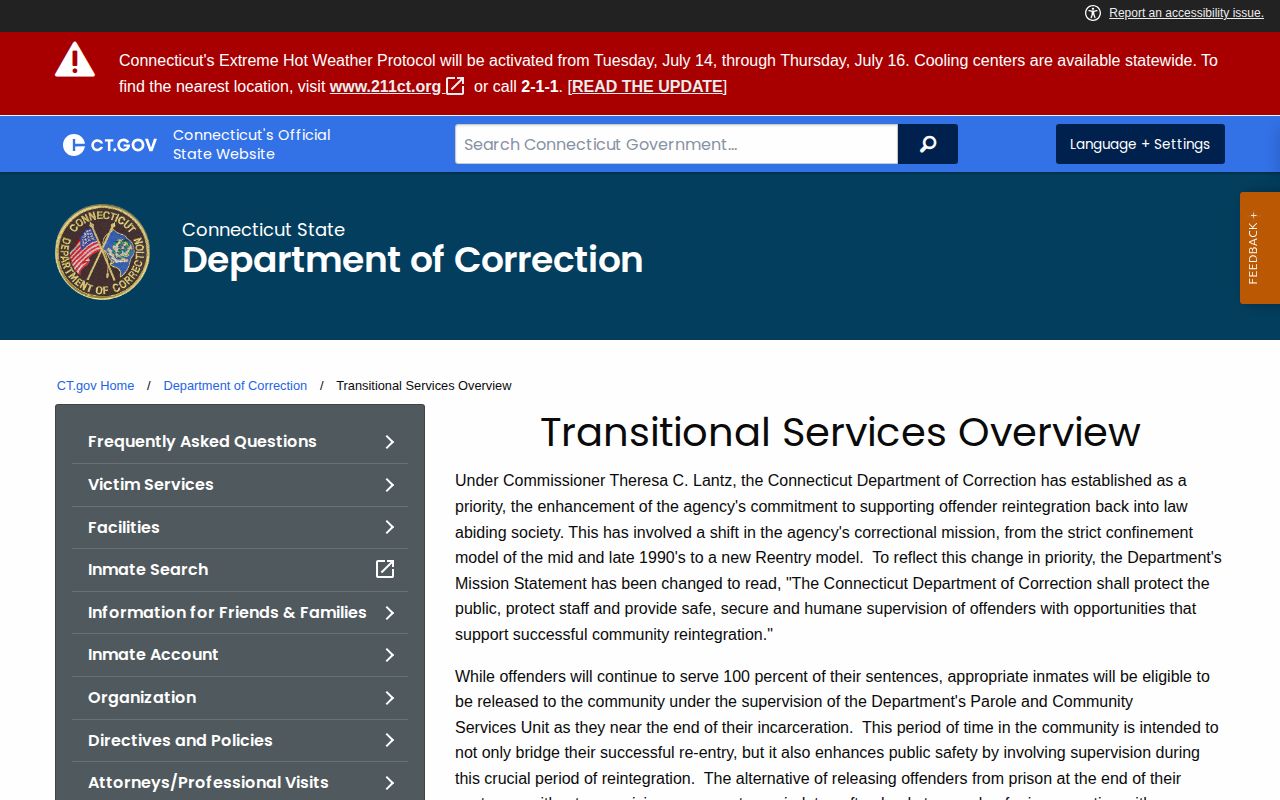
Release planning can begin before the date, but the final custody event still depends on the official sentence and release authority.
For a full custody-stage search rather than a date calculation, use the Stamford released-inmate search to separate police, state, federal, and immigration records.
Stamford Release Dates by Custody
The phrase "release date" changes meaning across Stamford's custody path. At police headquarters, release may occur by summons, promise to appear, bond, or court direction before CT DOC takes custody. The useful date is then the police release or court event, and the continuing case is checked in the Stamford docket. There is no DOC sentence estimate for that short local stage.
After arraignment, a male Stamford detainee may be held at Bridgeport Correctional Center and a female detainee may be held at York Correctional Institution. Pretrial custody can show a bond amount, current location, and status, but it still lacks a sentence-based release date. If a sentence is imposed, CT DOC uses the court's mittimus and Connecticut credit statutes to calculate the public Maximum and Estimated Release Date fields.
Parole creates another date layer. Eligibility marks when the Board may consider release under the governing percentage and offense rules. A grant can allow conditional release, but supervision continues. Special Parole End Date marks the later end of that judicially imposed term. Full discharge is therefore not always the date the prison gate opens.
A federal Stamford case belongs in the BOP Inmate Locator, while a known immigration transfer belongs in ICE's detainee locator. Ending CT DOC custody through a transfer does not prove return to the community. Always match the date to the agency that held or received the person.
Stamford Release Credits and Computation
The Stamford court supplies the sentence and judgment mittimus, while CT DOC applies Connecticut credit rules. C.G.S. Section 18-98d provides qualifying presentence confinement credit equal to the days spent in covered confinement. For offenses committed on or after October 1, 2001, it also addresses qualifying time in a police station or courthouse lockup when the person requests the credit at sentencing and the court records the days on the mittimus.
That police and courthouse provision is especially local to Stamford. A short hold at Stamford Police headquarters or the Stamford courthouse does not become a free-standing online release record. It can affect the state calculation only when the statute's conditions are met and the credit is correctly placed in the sentence record. Section 18-98d also provides a conditional good-conduct reduction of ten days for each thirty days of presentence confinement. It should not be described as an automatic Stamford county-jail rule.
Section 18-98e creates earned risk reduction credit for eligible sentenced inmates. DOC may award up to five days per month at the Commissioner's discretion for adherence to an accountability plan, eligible programs and activities, good conduct, and obedience to rules. Listed serious offenses and certain persistent dangerous offenders are excluded. Credits can be lost for misconduct or other good cause, and they cannot cut a statutory mandatory minimum.
Parole eligibility is another calculation, not a synonym for release date. The Connecticut legislative parole overview states that eligible non-violent sentences may reach consideration after 50 percent less risk reduction credits. Violent crimes, home invasion, and second-degree burglary are generally considered after 85 percent less qualifying credits. Some crimes are not eligible under the general rule. A parole-eligibility point does not guarantee a grant or set the final discharge date.
Note: The court imposes the sentence, but CT DOC computes credits and custody dates from the judgment and governing statutes.
Why Stamford Release Dates Change
An estimate can move because the facts behind it move. Some changes alter the number of credited days. Others change the sentence, release authority, destination, or public data. The table separates common causes documented in the Stamford research.
| Factor | Effect on the date or release | Best confirmation source |
|---|---|---|
| Sentence entry or correction | Changes the term or fixes the mittimus used by DOC | Stamford court docket and judgment |
| Presentence or lockup credit | Adds qualifying credited days under Section 18-98d | Court mittimus and DOC calculation |
| Earned risk reduction credit | May move an eligible estimate earlier | DOC record under Section 18-98e |
| Disciplinary credit loss | May move the estimate later | DOC institutional record |
| Parole grant, denial, or deferral | Changes the possible conditional-release path | BOPP hearing and decision records |
| Detainer or transfer | May prevent community release even when CT DOC custody ends | DOC detail, receiving agency, or ICE locator |
| Appeal, modification, or new case | Can change the legal basis or length of confinement | Judicial Branch court record |
| Processing lag | Leaves the public estimate behind the agency record | DOC Public Information and VINE |
A detainer deserves care. It can mean another jurisdiction or agency asserts custody when the current term ends. CT DOC release followed by transfer to ICE, federal custody, or another jurisdiction is not the same as return to the Stamford community. The destination must be verified through the receiving system.
Confirm a Stamford Release Date
Use Connecticut VINE to watch for the custody change, then use the official record to explain it. From a matching person result, registration may be available by phone, email, or text. A phone alert may require a PIN, and email or text may require a confirmation link or code. Keep the contact details current because a missed call or blocked message can interrupt the notice.
A VINE alert can indicate release or no longer in custody, depending on the agency feed. It may not state whether the reason was sentence completion, parole, bond, transfer, or another event. The Connecticut VINELink check explains the named-person notification steps. The Stamford court docket or CT DOC record remains the source for the legal reason and sentence calculation.
DOC Public Information can be reached at 860-692-7780 from 8:00 AM to 4:30 PM, Monday through Friday. Written requests go to the Public Information Office, Connecticut Department of Correction, 24 Wolcott Hill Road, Wethersfield, CT 06109. Ask about the specific public custody and release fields rather than requesting a prediction beyond the agency record.
Verify close to release: A public estimate can change, and a VINE status update may arrive after the underlying agency action.
Stamford Weekend Release Date Rules
Connecticut has a specific calendar issue for terms that expire on a Saturday, Sunday, or legal holiday. C.G.S. Section 18-92 addresses that circumstance. It explains why a simple count on a calendar may not match the date DOC processes the release. The statute should be checked with the current sentence record and agency practice instead of assuming a standard Stamford release hour.
This weekend and holiday rule applies to a term expiration, not every kind of release. A bond release follows the court and posting process. A Board parole release follows parole authority and DOC processing. An ICE or other-agency transfer follows the receiving hold. The recorded event is more reliable than a date calculated from the outside.
The Connecticut conviction and parole statutes provide context for the release and supervision rules shown below.
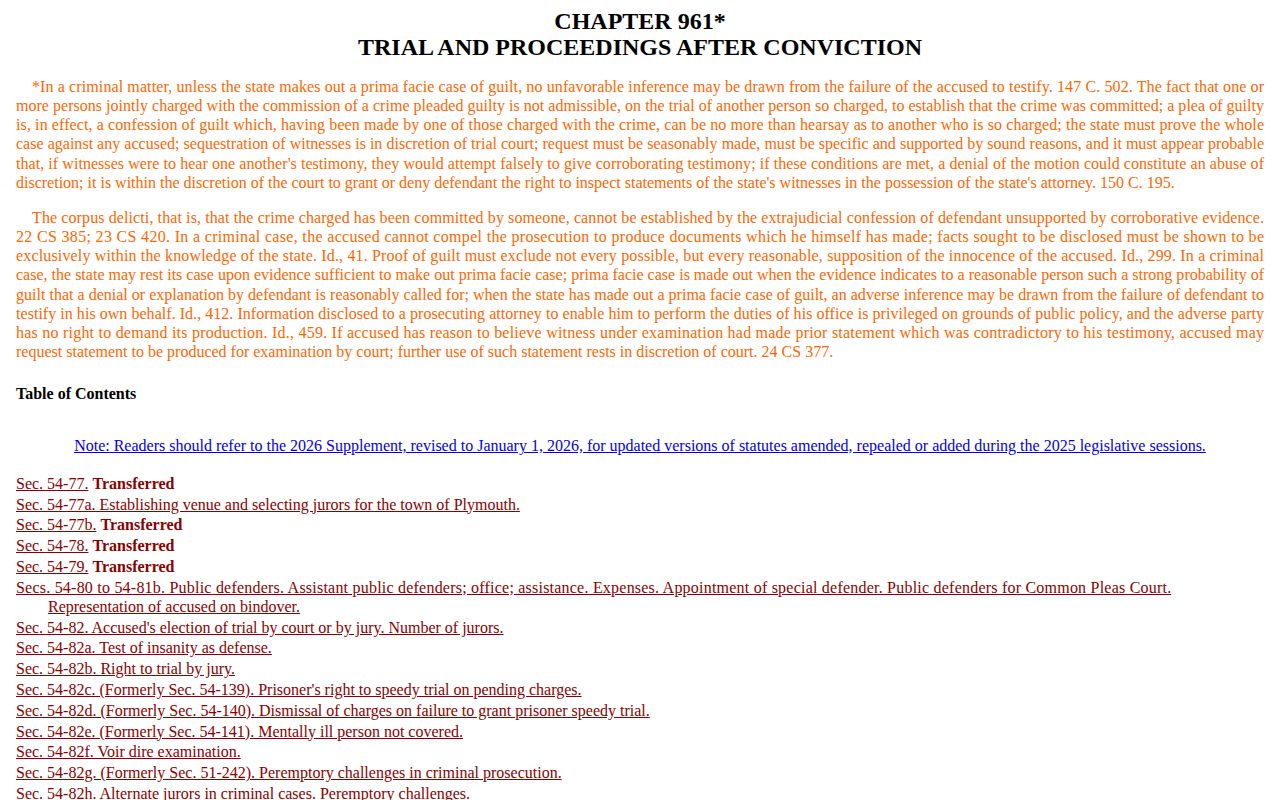
The statute page is a legal source for the statewide framework, while a named person's date still comes from the court and CT DOC record.
Note: Never infer a weekend release time when the public source gives only a date and no processing schedule.
Public Record Search
Sponsored Results