
Stamford Parole and Probation Compared
A Stamford release may lead to probation, parole, special parole, or no supervision at all. These are not interchangeable labels. Probation is a sentence or condition ordered through the Connecticut Judicial Branch. Parole is release from a Connecticut Department of Correction term under conditions set by the Connecticut Board of Pardons and Paroles. Special parole is imposed by a judge and starts after the prison portion of a sentence. A complete discharge means the relevant custody and supervision obligation has ended.
The distinction controls where to verify the record. A probation term is found in the Stamford court case and is administered through the Judicial Branch Court Support Services Division. Parole and special parole involve the Board of Pardons and Paroles and the DOC Division of Parole and Community Services. A person can be outside prison and still subject to strict release terms.
| Supervision | How it begins | Primary record | Responsible system |
|---|---|---|---|
| Probation | Court sentence or court order | Judgment and docket | Judicial Branch Court Support Services Division |
| Parole | Board-authorized prison release | BOPP hearing material and DOC custody record | BOPP and DOC parole staff |
| Special parole | Judge orders a term after incarceration | Court judgment and Special Parole End Date | DOC community supervision under Board conditions |
| Discharge | Applicable custody or supervision term ends | DOC, court, or Board record | Agency that held the active authority |
Connecticut law assigns probation administration to the Court Support Services Division under C.G.S. Section 54-105. The Board's parole authority, including granting, rescinding, revoking, and discharging eligible people, is set out in Section 54-124a.
- Parole
- Conditional release from prison before the sentence relationship is fully discharged.
- Probation
- Court-ordered community supervision, often tied to a suspended sentence or a non-prison disposition.
- Special parole
- A judicially imposed supervision term that begins after the prison portion of a sentence.
- Absconder
- A supervised person alleged to have left supervision or stopped reporting as required.
- Discharge
- The formal end of the applicable custody or supervision obligation.
Verify Stamford Post-Release Supervision
No single public Stamford lookup combines probation, parole, special parole, custody status, and discharge. Verification works best as a source sequence. Start with the system that imposed or administers the release, then use the other records to resolve gaps. A missing CT DOC result does not prove that supervision ended because the public tool is framed as a current-inmate search.
- Search the Connecticut Judicial Branch conviction lookup using Stamford Geographical Area 1 and Stamford Judicial District. Read the judgment for probation, suspended time, special parole, sentence date, and disposition.
- Check the CT DOC inmate information search by DOC number, or use the person's name and date of birth. A detail record may show status, detainer, estimated release date, and Special Parole End Date.
- Use Connecticut VINE for a custody-status change or release notice. Treat the notice as a status update, not the full legal reason for release.
- Review the BOPP hearing calendar when parole consideration or a recent hearing is known. Calendars, dockets, minutes, and streams may show the process, but Connecticut has no single name-searchable parole-decision database in the reviewed sources.
- Contact DOC Public Information or the proper supervision office if the public records conflict. Ask a focused question about whether the person is in custody, on parole or special parole, or discharged.
- Use the parole fugitive channel only to report absconder or escape information. It is not a routine supervision search.
For a named-person release search that begins before supervision is known, the Stamford released-inmate search path separates local police release, CT DOC custody, court disposition, and federal or immigration custody.
Important: A person released from CT DOC may still be on parole or special parole, while someone on probation may never appear in the inmate search.
Stamford Release Supervision Contacts
Stamford has no city jail parole office. Connecticut's Division of Parole and Community Services lists field offices in Hartford, New Haven, Bridgeport, Waterbury, and New London. Bridgeport is the relevant local geography because Bridgeport Correctional Center serves Stamford Superior Court custody. The source material does not provide a street address or direct field-office number, so those details should be confirmed through DOC rather than guessed.
Connecticut Department of Correction Public Information Office
24 Wolcott Hill Road
Wethersfield, CT 06109
Phone: 860-692-7780
Hours: Monday through Friday, 8:00 AM to 4:30 PM
Connecticut Department of Correction
Connecticut Board of Pardons and Paroles
Probation information begins with the Judicial Branch case record because probation is a court sentence. The Stamford location choices in the public search are Stamford Geographical Area 1 and Stamford Judicial District. If a docket shows probation but does not identify a useful contact, the clerk or Court Support Services Division can route the question without treating the CT DOC locator as a probation directory.
Note: Confirm the assigned office from the current agency record because a Stamford case can be supervised under statewide routing.
Stamford Release Conditions and Violations
Release conditions depend on the order. A probation judgment, a Board parole decision, and a special parole term can set different rules. The public record may show the supervision type and end date without listing every instruction given to the person. Court dockets are strongest for probation terms. BOPP and DOC records are stronger for parole, special parole, revocation, and rescission.
A violation does not automatically mean the same result in every case. Connecticut BOPP materials identify outcomes that include rescission before release, revocation after a violation, and action on a special parole violation. The Board's Revocation Unit conducts and schedules hearings and issues decisions in parole rescission and parole or special-parole revocation matters. A new court case, violation of probation, or failure-to-appear issue may instead appear through Judicial Branch records.
CT DOC lists a Parole Fugitive Investigations Unit tip line for parole absconders, transitional supervision escapees, and high-profile cases. The public-safety reporting contacts are 860-982-2372 and CT.FUGITIVE@ct.gov. They should be used for relevant information, not to ask whether a person is on ordinary supervision. For immediate danger, contact emergency services.
How Stamford Release Supervision Ends
Supervision ends through the authority that created it. A probation term ends under the court judgment and Judicial Branch administration. Parole may end through completion or a Board discharge under Connecticut law. Special parole follows the judicial sentence and can have an end date shown in CT DOC information. It is wrong to use a prison release date as the end of all legal supervision.
C.G.S. Section 54-129 addresses discharge of a paroled prisoner. Section 54-124a gives the Board authority that includes discharging an eligible parolee or inmate and terminating special parole under the governing standards. A court judgment, BOPP record, or DOC response should confirm the actual end. VINE is useful for custody changes, but a release alert does not establish discharge from parole or probation.
Older public records can change as well. Connecticut court information may be modified by erasure, correction, pardon, or other lawful action. If an old supervision result disappears, compare the current court record with the agency that administered the term instead of assuming the original record was false.
Note: Release from a correctional facility and discharge from supervision are separate events and may occur on different dates.
Stamford Release Planning Before Parole
Connecticut DOC's Transitional Services overview says discharge planning begins at least 45 days before release. Planning covers clothing, transportation, medical and mental-health treatment, identification, and aftercare arrangements. This is a concrete part of the release path for Stamford people leaving Bridgeport Correctional Center or York Correctional Institution.
Planning does not prove that parole was granted. It prepares for several kinds of discharge and community placement. The actual authority still comes from the court sentence, DOC calculation, or Board decision. When a family member sees reentry activity but no final status, the proper checks remain CT DOC, VINE, the court docket, and BOPP hearing records.
The DOC Offender Re-Entry Services page adds a practical link between custody and supervision. Transportation and aftercare plans can affect where a person reports after release, while the supervising office remains responsible for the formal release conditions.
Stamford Release ID After Custody
Identification can remain with DOC after a Stamford prison release. DOC says an identification document stays at the facility until discharge. If it is not claimed, the document remains at the discharging facility for 30 days, then goes to DOC Central Office in Wethersfield for up to two years. This detail matters when a person must report to supervision and lacks the ID held during custody.
Questions about retained identification can be directed to 860-692-6836, 860-692-7869, or DOC.ORSU@ct.gov. Those contacts concern ID held through the DOC reentry process. Property from a Stamford Police arrest is a separate local matter and should be addressed through the police agency that held it.
Stamford Parole Hearing Records
Connecticut publishes parole hearing calendars and public meeting material, not a simple Stamford parolee name search. BOPP says hearings generally begin at 9:00 AM unless posted otherwise and may occur Monday through Friday by video connection. A three-member Board panel hears the matter, asks questions, deliberates in open session, and gives a decision.
The State Agency Public Meeting Calendar can carry docket and minutes entries. BOPP also uses live links and a state hearing stream archive. These sources can help trace a known hearing, but records requests may still be needed for a specific decision.
The official BOPP hearings source is shown below. Its calendar and public links explain the state process that applies to eligible Stamford sentences.
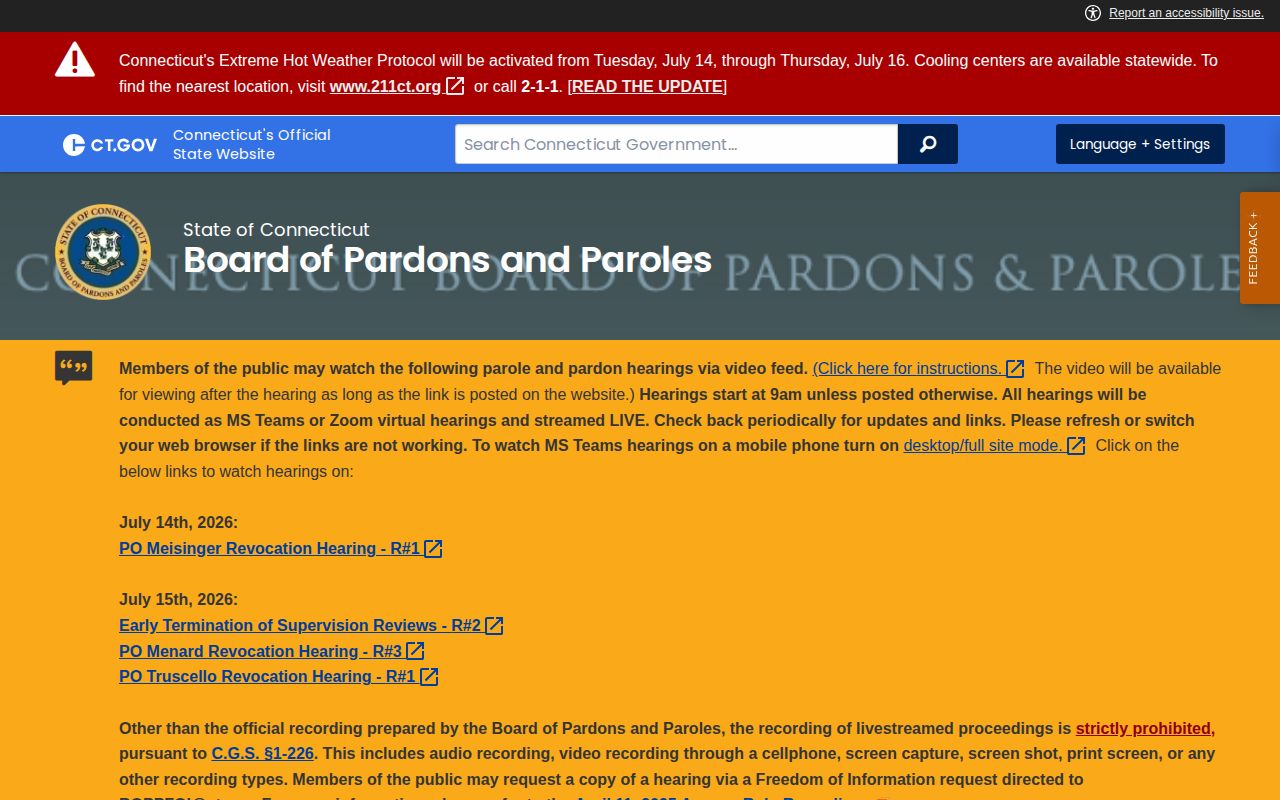
The captured page is a navigation point for hearing schedules and Board records, not proof that a named person received parole.
Public Record Search
Sponsored Results